Ways of seeing we inherit
The ideas that help us understand ourselves and imagine a future can also become the limits we place on ourselves.
What we can do. What we allow ourselves to hope for.
How we relate to others, and how we might live.
Through our experiences, each of us has developed a way of seeing ourselves and the world.
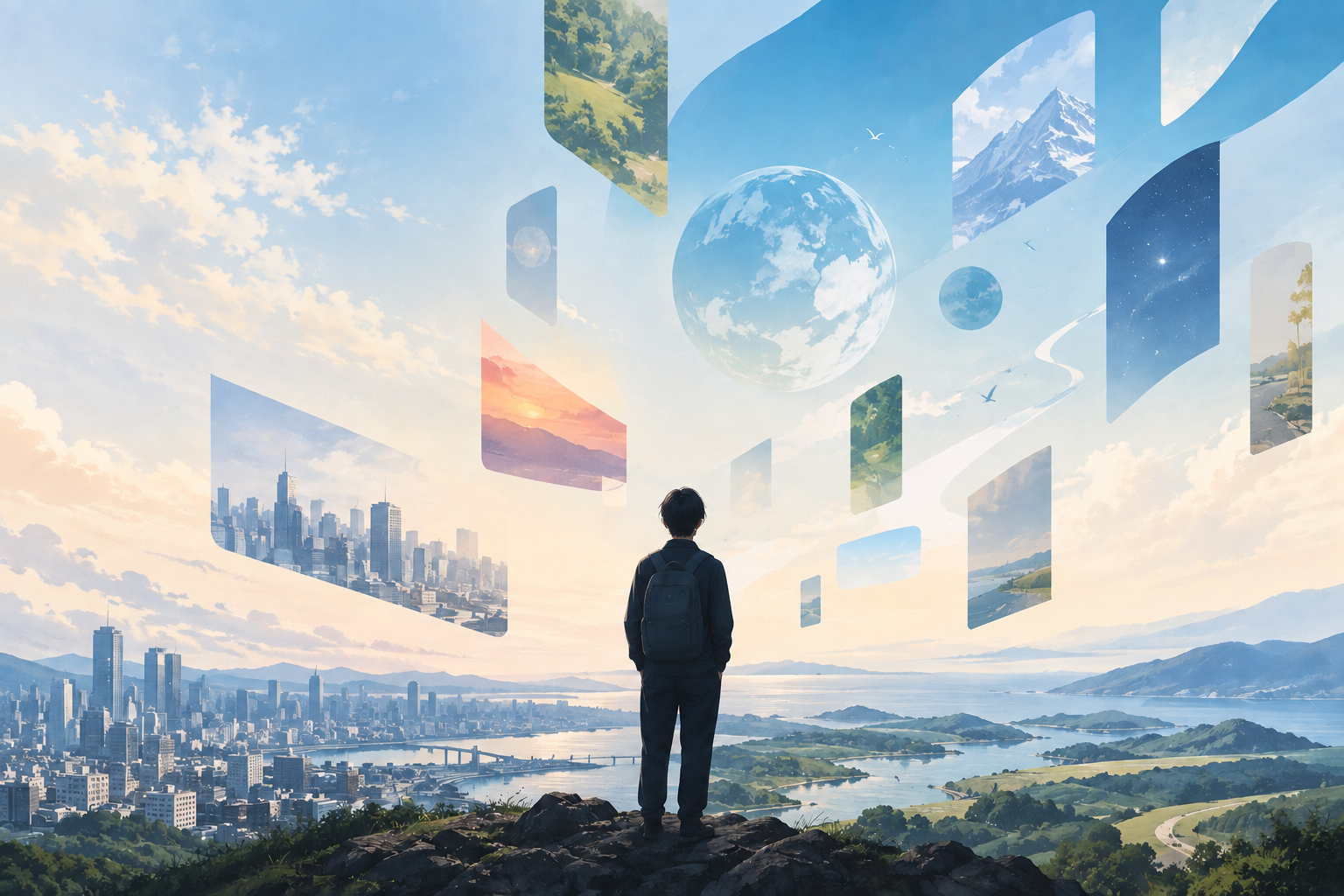
These ways of seeing carry the words we have heard at home, at school and at work, along with ideas our society takes for granted. “This is what success looks like.” “This is how you should live at your age.” They help us make sense of a complex world and find a direction within it.
Yet familiar ways of seeing can also draw boundaries around what feels possible, without our noticing. “I could never do that.” “That is just how the world works.”
What we see now need not define
all that we—or the world—could become.
Relationships with people we have yet to meet. Aspects of ourselves we have yet to experience. Ways of living that have yet to take shape.
Not everything unknown is a gap that more knowledge can fill. New encounters with people and places can bring possibilities into being that did not exist before.
As we encounter new people and experiences, our understanding of ourselves and the world can change. This is where I begin to think about the relationship between individuals and society.
“This is how I should live.” “That is not for someone like me.” The language we use to understand ourselves carries social judgments and past experiences. It can guide us through life, but it can also obscure possibilities we have not yet tried.
My aim is neither to discard every familiar perspective nor to find a new, definitive answer. It is to expand the conditions that allow people to shape their relationships with society through experience and encounters with others. This question sits at the heart of my research and practice.
The ideas that help us understand ourselves and imagine a future can also become the limits we place on ourselves.
The unknown is more than an empty space to fill. It leaves room for experiences we have not had and possibilities that may yet emerge.
Understanding also grows through engagement. We try something in the world, attend to what happens, and revise how we see ourselves and our surroundings.
I work with a sense of direction while keeping the methods open. What happens in practice can reshape the question itself.
A DAILY POINT OF CONTACT
I am developing dialogue that helps people see themselves from different angles, through experiences and possibilities, without fixing their present self-understanding in place. The app is one way of working with this question.
About this dialogue app Explore the appOne aspect revealed in a conversation should not become a fixed account of who someone is.
Allow another perspective to emerge, rather than rushing to fill every gap with an explanation.
Keep the conversation in touch with what people do and experience beyond the AI’s words.
“I don’t think I’m any good at leading people.”
Trace the experience behind those words, try engaging in the world, and return to the conversation with what happened.
An imagined conversation on the next page illustrates the design direction.
Building on doctoral research into international development from a sociological perspective, I explore how social meanings and categories shape the ways people engage with the world.
I am considering opportunities for dialogue and learning where people can reconsider how they see and engage with the world, alongside acquiring knowledge.
Change should not rest on individual effort alone. I am exploring how society can make it possible for people to choose and try a wider range of ways of living.
People in research, education, support work and technology are approaching related questions in different settings. I would like to bring those concrete questions and experiences into conversation.
We can work toward a shared purpose
without all using the same methods.
One person’s practice can prompt another’s next question or experiment. Over time, these relationships can grow into a wider network of mutual learning and collaboration.
I studied sociology at Stanford University and worked in international development. Today, I work in data science and AI development.
A question connects the different parts of my work.
The fields I work in have changed. Looking back, a central question runs through them: how human possibilities take shape through our relationships with society. This site brings that inquiry and practice together, and opens a space to connect with others.
LET'S BEGIN WITH A QUESTION
I would like to hear from people working with related questions. We can begin with a concrete experience or something you are wondering about. You do not need a fully formed idea.
Your message goes to Keiichi Takaki.
It will not be published on this site.